Saturday, September 8, 2012

Return to Kathmandu!


random Buddhist procession passing by in Lukla
          I woke up with a headache but for the first time in a long time it wasn't because of the elevation. This time I had chhaang to thank.  Chhaang (not to be confused with the Thai beer of the same pronunciation) is the local Sherpa brew-- it literally means "nectar of gods". The previous night my friends and I had a few too many celebration drinks and now it was time to get on an airplane back to Kathmandu. We were able to move our flight up so that we wouldn't have to wait around in Lukla for another day. After breakfast, I packed up my belongings and paid the bill at our lodge. The four of us made the short walk over to the airport, eager to get off the mountain.
          I should've known as I walked up to the Tara Air counter that there would be bad news. Even though the weather in Lukla was clear and calm, so was not the case at our destination and our flight-- the last flight of the day-- had been canceled. The airline rep pushed back our reservations to the second flight out the following morning.  This is exactly what happened when we began the trip, trying to get from Kathmandu to Lukla.
who needs 3-D glasses when you've got beer goggles?
          Frustrated, we checked in to at a hotel across the street. I killed the rest of the afternoon in a small internet cafe/ coffee house that had a huge TV playing movies. They sold Budweiser tallboys-- the first I'd seen anywhere in Asia-- and I took full advantage. I sprawled out, taking up the long couch in the common area, and drank beer while watching Tron 2 on the big screen. It was in 3-D, but I didn't have the glasses. By my third Bud tallboy I was able to see the missing third dimension.
          The next morning I woke up with fingers crossed. Luckily, the weather was great and everything went as according to scheduled. At 7:30 am, we boarded our flight out of Lukla back to Kathmandu. I was excited and a bit nervous as the plane set for a brief pause at the top of the runway-- then it made it's charge. We rapidly approached the end of the runway. In Lukla, when the runway ends... so does the ground. If the plane doesn't have enough speed to take off, it will go face first off the edge of the runway (and mountain), plummeting  into the valley below. We charged for 100 yards and just before we reached the edge of the cliff, our pilots pulled up and we took flight. As we soared through the Himalayas like a badass terodactyl, I soaked in the last views of the magnificent mountain tops peaking through the clouds.  (Watch my video of the sweet takeoff below...)
THIS. IS. SWEET...


           Once we were in Kathmandu we cabbed it to the backpacker district of Thamel where we'd stayed before. My friends and I checked back in to Traveler's Home, one of the best guesthouses I've ever stayed at in all of my travels. They greeted us with hugs and congratulations and quickly opened up two rooms for us. I took a much-needed hot shower and happily changed out of my awful trekking clothes.
back at Traveller's Home (Thamel-Kathmandu, Nepal)
           My first stop was the barber shop. I got a haircut and a shave for the first time in over a month. Finally... clean. The rest of the afternoon was spent walking around Thamel, doing some light shopping-- a few souvenirs and gifts. As we walked, shop owners through buckets of water on the dirty streets to keep the dust down. Relentless honking from the city traffic made me anxious. It had only been a few hours and I already missed the mountains and their quiet. My friends and I decided to get out of Kathmandu immediately and we booked bus tickets to Pokhara for early the next morning.
           Pokhara is known as Nepal's second city.  It's a small lake-side town sitting at the foot of the Annapurna mountain range. I looked forward to getting some rest and relaxation and sitting lakeside with a beer in hand for a few days. Pokhara seemed to be just what I needed.
the chaos that is Kathmandu

Wednesday, September 5, 2012

EBC TREK: Back to Lukla (Days 10-13)


DAY 10: Gorak Shep to Dingboche

          We began the return trip by hiking back to Dingboche. We made a quick pit-stop in Lobuche, but only for as long as was necessary. About half-way back to Dingboche (from Lobuche), the wind suddenly picked up, there was an instant drop in temperature, and thick clouds rolled in right on top of us-- all this accompanied by a light snowfall. After almost getting lost in the fog, we finally arrived back at Dingboche-- two hours after we'd planned.  
          This time we stayed at a guesthouse recommended to Leanne by a Sherpa-dude that she met in Gorak Shep (Moonlight- 200 NRS/night). It was infinitely better than the guesthouse we stayed in the last time we were here. Everything was new and clean and it was run by a friendly family staff. The common room was actually warm (that yak dung stove actually worked) and each bedroom had it's own bathroom. For us this was luxury accommodation for $2.25 USD/night! I ate Indian food-- Daal Baat-- for dinner and they gave me free refills. Then, the Sherpa-dude that ran the guesthouse sat us down for a pretty incredible story.

          He told us of how his son had summited Everest seven times-- once, he summited twice in one week-- before his was 27 years-old. On one expedition he and another Sherpa saved the wife and daughter of a rich client going to the summit. To repay his thanks for saving his family, the millionaire flew the two Sherpas to the U.S. where he owns a watch company (Kobold watches). The thankful millionaire put the two Sherpas up and paid all expenses for 10 months as they trained and learned everything there is to know about watch-making. Now, the two Sherpas run the Kobold factory in Kathmandu, make more money than they could've dreamed of before, and they never again have to risk their lives in the mountains. Pretty sweet story.  

DAY 11: Dingboche to Tengboche

          For the first time in a long time I woke up feeling pretty refreshed. We had an early start and the weather on the trial was great all day. As we continued to drop in elevation the change was noticeable. By the time we reached the treeline (about half-way back to Tengboche) I felt much more energized, clear, breathing was easier, and I was even to get down to a short-sleeve T.
Baby Himalayan Goatcowsheephorseyakdog...
AKA... the Remus.
          On a hillside I noticed what I first thought was yak that had strayed from home. He was stumbling and making strange noises and I got closer I decided that it was more likely a super-hybrid of a goat-cow-sheep-horse-yak-dog. This may be what many people have witnessed as the legendary yeti or abominable snowman. I call him by a new name... the Remus-monster.
"YETI SKULL" at a Buddhist monastery
          The second half of the day's trek was much longer than any of us had remembered and the ascent at the end was seriously steep. When we had set out on our return trip I thought, “Well, it's all downhill from here... literally!” Wrong. I guess I never noticed all the downhill sections of the trek on our way up to Base Camp. When you're walking downhill it's easy and there's no reason to remember that specific section of the hike. However, on the way back, alllll those descents are now ascents and there's no way around them. By the time we reached Tengboche we were all beat. We checked in once again at the Bakery where Mike and I mashed chicken burgers and fries (No more Sherpa stew!), apple pie, for two much-needed and well-deserved beers. 


DAY 12: Tengboche to Monju

          We got started at 9 am and the first task was to tackle the mountain that Tengboche sits atop of. Luckily, this time we were going down. Still, it was steep and rocky and five steps into the descent, Brittany fell on her ass- not off to a happy start. Mike went ahead and I walked with Britt and Leanne. It took Mike only 45 minutes to get down and it ended up taking the three of us closer to an hour and a half. We rendezvoused at the bottom of the mountain and Mike decided to go ahead again, at a faster pace, and meet us at Namche Bazaar.
Doin work!
          Slowly but surely we went up and down over peaks and through valleys and finally we arrived back at Namche and met Mike at the Everest Bakery. We ate (I usually don't support veggie-burgers, but this place did it right), rested, and got back on the trail for the final leg to Monju ( or Monzu). It took about 45 minutes to descend from Namche but other than the uneven terrain it was fairly easy.  Together, we crossed the suspension bridge that I remembered so vividly from the first half of the trek and we pressed on at a good pace to Monju. Just as it was getting dark we checked in at Mt. Kailash (guesthouse) and sprang (700 NRS/ $7.85 USD) for a room with a bathroom and a hot shower.
          The day's trek was supposed to take about four hours, instead it took closer to seven. I let Britt take the first shower and I laid on the bed resting from the long day. This hot shower added an extra 200 NRS to the cost of the room, but I didn't care. I deserved it. When Britt finished I walked into the bathroom eager to get clean and warm with the hot water. Unfortunately, she used all of the gas for the heater and I was sprayed with ice water. At least it woke me up.


FINAL DAY of trekking- DAY 13: Monju to Lukla

          Everyone was up and ready to go in a good mood. We ate breakfast at Mt. Kailash and enjoyed the deck-view overlooking the river not too far below. It started out as a beautiful day and the weather was perfect. I was still sick but felt much better and was really enjoying hiking again. The lower altitude was so much better to hike in. There's thicker oxygen to breath and birds to listen to. Once again below the tree line, you trade the dusty landscape for waterfalls and rhododendrons. The scenery is sightly and the weather is enjoyable.
          We made a pit-stop in Pakding and ate some steamed momos for the last time. We filled our water bottles and started out on the final leg of our two-week ultra-trek and... rain. Everyone had rain gear except for Mike who wrapped himself in blue plastic and looked like a Smurf-wizard. I didn't mind the rain. I actually enjoyed it. Thick fog and clouds rolled in to accompany the rain and swallowed us whole. It felt like we were on the path to Moridor.  Good thing the Smurf-wizard was there to protect us.
          We hobbled along the cobble stone path, over a couple more bridges and conquered the closing ascent of our trek. At the edge of town in Lukla, we passed through the archway that signified our start, and now our finish.
crossing the finish line...  VICTORY!


CHECK OUT THIS SHORT VIDEO I THREW TOGETHER FROM THE TAIL-END OF THE TREK... I ORIGINALLY PUT IT TOGETHER WITH MUSIC BUT GOT A COPYRIGHT NOTICE ABOUT TH ZEPPLIN SONG I USED SO HAD TO TAKE OUT THE AUDIO... WORKING ON IT...

Monday, September 3, 2012

EBC TREK: Gorak Shep to Everest Base Camp (Day 9)


          The day that I'd been waiting and working for had finally come and all I felt like doing was sleeping. The previous day's scramble up Kala Patthar had pushed me to my limits and I was now laying in bed feeling worse than ever before during the trek. I had a fever. I couldn't breathe through my nose. My throat felt like it was swollen shut and every cough felt like it was tearing it open. I finally gave in and started taking the Diamox to help subside the symptoms of the mountain sickness since we wouldn't be going any higher in elevation after Base Camp. Mike and the others asked if I wanted to take a rest day but I just wanted to get it over with. Nut up or shut up. 

Everest Base Camp

          The hike to Base Camp takes about 6 ½ hours roundtrip. Unless you bring your own tent there's no lodging or accommodation at base camp. We didn't bring tents so we kept our rooms in Gorak Shep another night. The plan was to trek out to the Khumbu Glacier upon which Base Camp sits, walk around, take pictures of the camp and the icefall, and then head back to Gorak Shep before the sun went down.
          Once we started walking I felt a little better. The trek out there was pretty easy-- walking along rocky ridges with a few gradual ups and downs. Whatever mercy the terrain showed the cold made up for. It makes sense that the farthest point in our journey would also be the coldest.
By the time we reached Base Camp I had tons of good pictures. There were some great shots of Base Camp still in the distance and a few of both the the glacier and icefall. Still, the best views of were from Kala Patthar the day before. In fact, because of it's location you can't actually see Everest from Base Camp. Even so, there was plenty to take in.
Khumbu, baby.  Glacier chillin.
          I walked into Base Camp and I could hear creaking and cracking of the blue glacier below my feet. I'd made it to the finish line. I'd reached my goal. This was it. 5,364 meters in elevation. 17,598 feet. EVEREST BASE CAMP... and all I wanted to do was take a picture and get back to my room in Gorak Shep and go to bed. As terrible as I felt, I tried to appreciate the moment.
"YOU DISRESPECT THE MOUNTAIN!"
          When you reach Base Camp, there's a boulder covered in graffiti-- decorated with prayer flags and the signatures of those that made it this far. In the background, a blanket of white lay speckled with the orange and yellow of so many trekkers' tents. My friends and I waited for other groups to finish and then took our turn taking pictures next to the makeshift monument. Leanne had a plan the whole trip to take a picture at Base Camp in her bikini and she had every intention of following through. Despite the freezing cold, she stripped down and posed in her two-piece only to get sternly yelled at by several Sherpas for “disrespecting the mountain”. 
THE CREW
          Leanne and Mike wanted to stay at Base Camp a little longer to walk around and check it out. Britt and I were satisfied with what we'd seen and done and decided to head back. The wind picked up and it was long, cold trudge back to Gorak Shep. We arrived just as the sun was falling behind the mountains. Garlic soup and lemon tea was my victory meal. After dinner I fell into my bed exhausted and accomplished. After nine long days I'd reached my goal but the journey was far from over-- I still I had to go all the way back.
Arriving at Base Camp... more tents beyond the ridge but not much to it.


rep the Naptown jersey.  yeeeahh buddy.

Friday, August 31, 2012

EBC TREK: Lobuche to Gorak Shep & Kala Patthar (Day 8)


Level ground leaving Lobuche... nice and easy.
          We woke up early to get a good start on everyone else in Lobuche. It was said that there were only a few guesthouses in Gorak Shep, our next destination, and I didn't want to risk spending another night in this infested slum. Still, as we were getting ready at 6 am there were already entire teams setting out before us. We hurried and ate our egg breakfasts, paid for the deficient accommodation, and set out.

View from atop the rocky bluff-- those little black dots on the left side
are people trekking below


          Mike and I went ahead to try and get to Gorak Shep quickly so we would have rooms for the night. The first 40 minutes was rocky, but flat and easy. There was a short but steep ascent up a rocky bluff. Then up and down, up and down, up and down cold and windy winding paths. By the last ascent we had caught up with the first groups to have left Lobuche that morning and ended up passing them.        We made good time (1 hour, 58 minutes to be exact) from Lobuche to Gorak Shep.


          We checked in at the first lodge we came to (Himalayan Lodge & Restaurant-- 300 NRS/night) and got two rooms. We dropped off our bags and doubled back, finding the girls about a half hour behind. We helped them with their gear and guided the way. It was only a little after 9 am when all of us arrived in Gorak Shep (5164 m/16,942 ft)-- the original base camp for Mt. Everest. The day was young and the morning's trek had been one of the easiest of the whole trip. We decided to take advantage of our extra time and make a day trip and hike up Kala Patthar, a nearby mountain sitting below “the impressive south face of Pumori”. I stood and looked up at Kala Patthar, dark and rough. “It doesn't look that bad,” I said. In the following hours I would eat those words.


Kala Patthar


          Just next to the our lodge in Gorak Shep is an open field of dirt, an ancient lake bed, with a makeshift helicopter landing pad made from large rocks. On the other side of this dirt lot is the foot of the mountain Kala Patthar. It pales in comparison to the size and beauty of its surrounding neighbors, Lhotse, Everest, Nuptse, and Pumori. It is dark and dirty and littered with giant boulders. There's no wonder Kala Patthar means “black rock” in Nepali. It looks dead, like a mountain of the moon. Still, I was surprised to hear that it takes 2 to 3 hours to reach the top. Again I mumbled to myself, “It doesn't look that bad.”

Shortly after starting the hike up Kala Patthar-- the
 town below shrinks and the mountains grow.
          After already having hiked 2 ½ hours that morning, we set out to tackle Kala Patthar, where the views of Everest are second only to Everest's peak itself. Mike and I started out with strength and energy and before long the girls were behind us and out of sight. The weather was decent. Almost immediately I realized that the ascent was steeper than it appeared. We stopped about half way up for a short water break, to catch our breath, and to check out the view so far. Below, the settlement of Gorak Shep now looked like nothing more than a small campground.


          We climbed and we climbed. Ridge after ridge, I thought I'd be able to see the top but nothing was revealed except more even ridges and even more rocks. So on we went and soon enough, the top was in sight. I battled the wind and dug into the hard, cold dirt and pushed forward until there was no more trail. Sharp and unstable knee to waist-high boulders now covered the ground and the hike turned into a scramble.

          Using my hands for balance and leverage I proceeded just behind Mike, only being able to take three steps at a time without having to stop and catch my breath or sit down from dizziness. The unforgiving terrain and temperature combined with being sick and with exhaustion began to weigh heavy. I was more fatigued from the early morning hike than I realized and the extreme elevation was taking it's toll. There had been previous sections of the trek that were difficult and there had been more than one time where I was uncomfortable, to say the least. But at this moment more than any, only a few dozen rocky meters from the peak, I was truly struggling. Even Mike the Mountain Man-- who before now had been healthy and seemingly unaffected by the altitude and the physical labors of the trek-- was having trouble making his body do what he needed it to do. I felt exhausted, nauseated, and lightheaded. Mike and I looked at each other. We looked at the top. So close-- maybe 50 yards away--So far. I sat to catch my breath one more time and gathered my composure. I lifted my head and looked above at the nearby summit. It was wrapped in strands of prayer flags and I stared at them blowing in the wind like a finish-line. I got up and pressed on. 
          I climbed and jumped and fell over boulder after rock. The prayer flags started to get closer and soon the 8 or 9 people waiting at the top had faces. I sucked in the thin air as we scrambled forward over the last few rocks and to the top. The top. I made it. Mike and I high-fived, sat down, and ate a Snickers at 18,300 feet (5,550 m). I looked around at the panoramic view and after only a few minutes of rest I felt fine. 

          The view was the most beautiful thing I have ever seen. At the top, of this mountain, Kala Patthar, suddenly turned into a little hill. I felt like I was sitting inside a bowl. We were surrounded by the Earth's most impressive giants. There's no wonder the view from Kala Patthar is called the "Crown of the Himalayas".  I looked all around and then locked my eyes straight ahead and stared into the distance. I was taking in the world's second-best view of Mt. Everest. Far below, yellow dots speckled a distant glacier. These were they tents set up at Everest Base Camp-- the ultimate of our trek.
          From the very beginning, the trek had been full of ups and down, both literally and figuratively.  But at that moment everything was worth it.  We took pictures of the mountains and of ourselves and when the wind started to pick up even more we decided to go back down. Twenty minutes into the descent... “No way... Is that...? It is... Holy $*#%!”... it was the girls. 


          We were happy to see that they never quit. I have to say, I was really impressed. Today had been incredibly demanding and they were determined to make it to the top. Mike and I decided to go back up again, this time with Britt and Leanne.  We took more pictures at the top and as the temperature continued to drop and the wind steadily picked up we raced back down Kala Patthar. When my feet touched that sandy lot at the bottom I felt happy. I felt bruised. I felt sick. I felt accomplished. But most of all, I felt like a nap.  The following day was a big one-- I would finally attain my goal and journey's end of reaching Base Camp.


Sunday, August 19, 2012

EBC TREK: Dingboche to Lobuche (Day 7)


          The night before we were told that there are only a few guesthouses in Lobuche and that they fill quickly so we'd need to get an early start. We did not. After finally getting on the trail around 8:30 I was not happy. It was windy and cold and there was still snow on the ground from the night before. With large tour groups on the trail ahead of us, Mike decided to hurry and go ahead so that we could be sure to get a guesthouse for the night.
          I fell back with the girls and we picked up the pace, making up time. We climbed out of the valley that Dingboche sits in and the morning fog thinned. Other than the cold, the first half of the day's trek proved fairly easy with only gradual slopes and some of the best mountain views we'd seen yet were revealed.
       
          The whole morning had been spent following a steep mountain ridge that finally descended to a small river cutting through another valley. We crossed a walking bridge and stopped briefly for a water break. We'd arrived at the most challenging section of the day's hike. Just ahead was a steep ascent up rugged and rocky terrain. It was quite literally an uphill battle that ended up taking us almost 45 minutes to reach the top.  
Memorial for world-class climber Scott Fischer who died
leading an expedition up Everest
          Once we reached the top we stopped for a break and to take pictures of the awesome scenery. Upon the hilltop were masses of stupas and chortens. Chortens are more than just decorated rock piles.  They are shrines-- stone monuments for Sherpas and trekkers who have died on the mountain.  This area of the trek was covered with them.  After we'd caught our breath and captured some great photos, we pressed on, trekking for another hour until we reached Lobuche. 
prayer flags and chortens
          Snow was falling lightly as we arrived and it continued all night. The weather was no longer enjoyable. Worse than snow were the constant cold and fierce winds. To add, the terrain was getting more and more rugged-- more like what you would picture when thinking of a desolate, bouldery terrain above the tree line. Streams were now iced over and the ground was frozen and stiff. The beautiful mountain landscape in the distance was a pleasant but brief distraction.  I was sick of being cold. Sick of dry eyes, chapped lips, and a runny nose. Sick of being sick. Sick of tea, coffee, and hot chocolate-- but they were the only damn way to keep warm.  But this is what we'd come for-- a challenge and an adventure to Mt. Everest.  It was definitely both.
Should've said "Welcome to Hell"
          Mike arrived at Lobuche an hour earlier than Brittany, Leanne, and I.  Luckily, he was able to get us two rooms (if you can call them that) for the night. It was by far the worst place we'd stayed so far. Two dirty mattresses laying inside of wooden box with a hard-plastic window. A paper bag type cloth covering the thin plywood walls was the only insulation. There was no flooring, just a plastic tarp covering the hard frozen dirt that was the ground beneath us. It was the most basic of protection from the elements, shielding us from the snow and wind and nothing more. The cold was inescapable. It was almost as bad as being outside.
my "room" in Lobuche (check out the video below for more)
          We dropped our bags and looked around outside.  Lobuche is much smaller than any of the other "settlements" we had stopped at.  It consists of nothing more than a few lodging establishments and is infamous for its filthy simplicity.  And so we headed to the common room.  It was slightly warmer there, only because this is where everyone was. It was a large room with tables and chairs and there were two yak dung stoves that seemed to produce nothing more than stink, definitely no heat.  Cold cold cold cold freaking cold cold. and sick. and COLD. At this point I was considering taking the Diamox to ease the impact of the elevation. For the rest of the night, I sat reading in the common room, bundled up. I saw a suspect-looking Sherpa dude wearing flip-flops eyeing up my boots. I had taken them off and put them next to the stove-heater to warm up. I quickly put them back on for fear of them being stolen. The last thing I needed was to be stuck on top of this mountain with bare feet.

WANT TO SEE THE CHORTENS, SOME MOUNTAINS, AND MY "DELUXE ACCOMMODATION" IN LOBUCHE?  CHECK OUT THIS QUICK 2-MINUTE CLIP I PUT TOGETHER FROM DAY 7...

          It was another night of me going to bed early. The next day we were to walk to Gorak Shep, only about two hours away but supposedly even less of an establishment than Lobuche. We'd have to be walking by 7am if we wanted to get rooms. The good news: Gorak Shep would be our last stop before reaching our goal of Everest Base Camp.


NOTE: The aforementioned book that I finished that night was Escape from Kathmandu by Majushree Thapa. This is a great read about the political history (or lack thereof) of Nepal and I 'd highly recommend it to anyone traveling to Nepal or interested in the country's past and current struggles. It's a bit tough powering through the dry history of the political parties and leaders, but ends up being very eye-opening and I'd even say suspenseful. This is probably one of the best books addressing the current Nepalese political state, the situation with the Maoist rebels, and their fight to establish a real democracy.  Eat your knowledge-- check it out!


Monday, August 13, 2012

EBC TREK: Acclimatization in Dingboche (Day 6)

End of day 5:

           We approached like cowboys riding in on a nearly dead town. It was silent except for the wind whipping against the prayer flags. The town should've had an Old West name like Misery or Tombstone but instead it was called Dingboche. Dingboche is small and simple. There are couple general shops, a bakery (there's always a bakery), two obnoxiously overpriced “internet cafes”, and a few teahouses.
Welcome to Dingboche
Population: 201
Elevation: 4530 m/ 14800 ft
           We settled on the first one we came to, creatively named Dingboche Guesthouse and Restaurant. Again, we negotiated free accommodation for buying all our meals here. It was a plain guesthouse. The bed rooms were small and smelled of their thin plywood walls. No running water and no electricity. The common room was a good size. It consisted of a small stove-heater in the center. Each wall was lined with a pillow-covered bench. Each bench had a table in front of it. If this were an Old West town there'd of been a big bear or bull skull on the wall, but we were in Nepal so instead they hung the skull of a yak. 
 The common room at Dingboche Guesthouse 
       
 If I was a cowboy, the Sherpas would be the Indians acting as friendly guides and liaisons to their native land. Sherpa people lead simple but not easy lives. It's always cold but the Sherpas never look bothered by it. Perhaps it's because they've inhabited the eastern Khumbu region for hundreds of years. Although most Sherpas don't get much of a formal education, they all speak English (a valuable and necessary skill for the tourism industry). After generations of living at and adapting to high elevation, the Sherpas have the ability to perform strenuous labor with less oxygen, making them the best mountain climbers and guides in the world. Generally, they're short in stature, but noticeably strong. They have a unique ethnic look, not obviously east-Asian or Indian. The visibly genetic traits are uniquely their own. Friendly sun-squinted eyes decorate a weathered face with rosy cheeks. Every Sherpa has rosy cheeks.
Big Momma Sherpa... ran the guesthouse
Day 6 (2nd mandatory acclimatization and rest day):

          The extreme elevation does something to a person's bladder. On average I would have to wake up four times every night to pee like a race horse. This was not fun. An hour or so after finally falling asleep I'd get an uncomfortable urge. I'd pull off the large wool blanket that was the only thing keeping in the warm bubble my body heat created. At night, it felt just as cold inside as it felt outside, minus the wind. It would take a minute for me to rub my eyes and find my head lamp and turn it on. Then, I would trade the wool booties for my hiking boots as to not soak them in the other people's urine that covered the bathroom floor. There always seemed to be a small puddle or stream surrounding the toilet where prior pissers' flash lights or aim or both had failed them. It was like a moat. A pee moat. It became like a game to me and I got pretty good at it. Standing on one side of the moat and peeing into the toilet on the other. I thought of it more like the 3-point line in basketball. Having to go really bad at that elevation, there's already a decent amount of pressure allowing you to shoot from a good distance. Combine that with a slight backward lean and you get a beautiful golden arch. If need be you can pinch a bit towards the end to create the garden hose effect. This, along with a few well-placed grunts are essential for sinking the last few drops. After this, I would return to my room and form a new cocoon in my blanket, only to sleep another hour and a half before having to wake up and repeat the process.

          The next day greeted me with my usual morning headache and cough. I dressed and went into the common room for some apple porridge. After eating I walked around the town to see what it had to offer. I saw smoke coming from a small establishment with beer signs in the window and a Sherpa man welcomed me inside. He handed me a cold beer and led me to a backroom where a man-on-man game of Russian Roulette was taking place. Old Sherpas were cheering and smoking cigarettes and taking shots of Himalayan moonshine as they placed their lowly bets on which contender would pull the trigger for his last time. And then I... okay, okay... none of this last paragraph really happened. The truth is, when I went out to find what the town had to offer, I quickly discovered that the answer was absolutely nothing.  It was a ghost-town.  I saw a few yaks, some rocks, and a tumbleweed.  Sorry, no gambling Sherpas with pistols.
view of Dingboche from a hill top... not much to it.
          Only 10 am and already bored, I returned to the guesthouse and paid for a hot shower-- my second shower since the trek began. The further along the EBC trek you go, the higher the price is for a shower, especially a hot one. I paid 400 NRS (about $5 USD)-- later on I saw prices get as high as $20 USD! Many people go the entire trek without taking a single shower. The shower that I used was in a small outside shack. It consisted of an electric water-heater with a hose that was rigged to a pail with several holes drilled in the bottom serving as the shower head. I washed my body and washed my clothes. Steam filled the shack and cleared my sinuses and for a minute I felt normal again. I would have happily paid twice as much. 
keeping warm
          The rest of the day was spent in the common room. I rotated between reading, eating, sleeping. The temporary sinus relief from the hot shower was short lived and my head began producing surprising amounts of green and yellow mucus. It was pretty impressive actually. I blew my nose every three minutes and the pile of Kleenex on the table in front of me grew larger as the hours went by. Other than my book, the only entertainment was watching the two year-old Sherpa baby named Lokba. He waddled around the common room and make faces at us while his mother broke up “yak chips” for the furnace with her bare hands. I hope she washed them before making my dinner but I doubt it.
Lokba Sherpa
          At night the common room filled with other travelers. I watch through the window as a thick fog rolled in and visibility outside was reduced to less than 10 feet. Sitting at the table next to us, was a middle-aged Japanese trekker and his guide. Mr. Roboto kept to himself and didn't speak to anyone, unlike his guide who, like most Sherpas, was friendly and talkative. The guide and my group made small talk and we asked some questions about the upcoming days of the trek and what to expect. He told us that our next destination, the town of Lobuche, only had a few guesthouses and that they filled quickly so we should get an early start in the morning to beat the large guided groups of trekkers. Waking up early meant going to bed early so I took his advice and, already exhausted from a day of doing nothing, I went to bed.


Saturday, August 11, 2012

EBC TREK: Tengboche to Dingboche (Day 5)


          I had a splitting headache and a grating cough. Nausea, fever, and fatigue cramped my body. I would continue to wake up in this manner for the next ten days. The horrible cold was bad enough and now the altitude was getting to me. It was like having a hangover without getting to have fun the night before. I'd previously made the decision to try and complete the trek without using of Diamox, a medication for treating altitude sickness (AMS).
          Eat your knowledge: Diamox is helpful for adjusting to breathing the thin air of high altitudes and relieving the symptoms of AMS. However, it doesn't actually treat the sickness. This can be dangerous. The symptoms are your warning signal that something is wrong and if they're being suppressed, you may not realize the severity of the condition. Continuing on with a trek and climbing higher in altitude while sick can be deadly. For this reason, I was avoiding taking the Diamox.
This guy greeted me when I opened the door from my room
          I put two more layers on top of what I already was wearing.  I was expecting to feel a rush of freezing wind and to see a layer of fog like the night before when I opened the door . I was pleasantly surprised when I felt sunlight on my face and the air was clear and crisp. Instantly my ailments seemed to fade. 
          Outside, several groups of early risers were walking around on the green grass taking pictures of the Tengboche monastery and taking in the views. The legendary mountain vistas that were guarded by the fog the night before, were now perfectly visible. I wandered over to a group of people looking and pointing and overheard them spouting off the names of several distant peaks. I followed the direction of their pointing fingers and noticed one that stood out from the others. It was far away, but it's beauty and size were apparent and intimidating. A trail of snow crystals whipped from it's summit and seemed to stand still, frozen in the air above the mountain. I was taking in my first view of Mt. Everest.
My first view of Everest... you can see the snow-whipped peak on the left.
          I met up with my crew at the bakery, mashed an apple pancake, and we hit the trail once again heading to our next checkpoint, Dingboche. We weren't on the trail long when a man jogged by us wearing only a light jacket, a small backpack, and a number pinned to his chest. Then another and another, each coming from the direction we were heading. A yak-train crossing a small suspension bridge forced to stop for a few minutes and we had the chance to talk to one of the runners. He told us that he was competing in the world's highest marathon, the Everest Marathon, starting at Gorak Shep (5184 m) and finishing at Namche Bazaar where we were two days earlier. I couldn't believe it. I was having trouble just walking around and this dude was racing in a freaking mountain-marathon.
Leanne and Brittany trying not to get run over by the yak train

          With my ego a bit deflated and self-confidence slightly bruised, I continued on. My friends and I followed the winding river far below us as we trekked along the mountainside path. For much of the trek, we could see Everest and several other fabled peaks far in the distance. The first half of the trek was pretty easy, mostly descents or small, gradual ascents. After two hours we stopped in a small town (Pangboche) on the river for lunch.

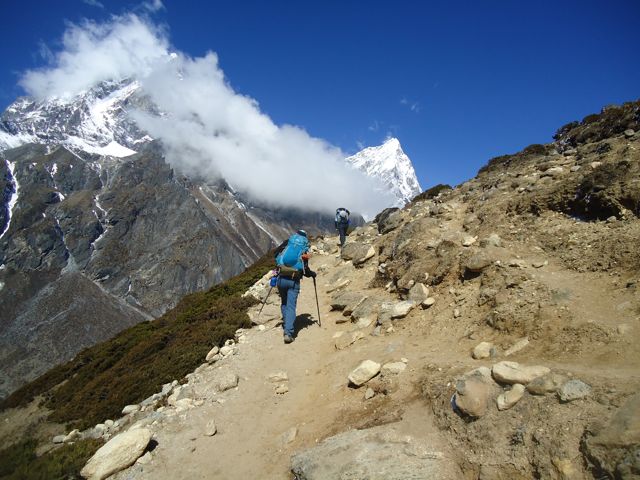
          We ate and started hiking again and shortly after, I realized that we had passed the tree line. This is the “edge of the habitat at which trees are capable of growing”. I don't recall the exact elevation, but the tree line is much higher in the Himalayas than in North America. I hardly noticed the transition from lush forests to the suddenly barren terrain.  Tall green trees were replaced by colorless rocks and small shrubs.  Harsh winds picked up as we proceeded through the rocky valley. I thought of the woman in Kathmandu that gave me a free buff to protect my face and I was thankful. Coming out of a daydream I rounded a bend and in the very near distance I saw our destination. We'd made great time and after only four hours total, we reached Dingboche (4,530 meters) where we would stay the night and again the next day for our second mandatory acclimatization camp.
from beautiful...

... to barren